Compression Set: Why a Gasket Can Lose Its Sealing Ability
Permanent deformation under compression is a fundamental property of elastomers. Understanding it helps in choosing materials and solutions that stay reliable over time.
A gasket must be elastic. It is precisely its ability to deform under pressure that allows it to conform to surfaces and contribute to the seal of a component.
But elasticity is not a permanent characteristic.
When a gasket remains compressed for a long time, especially at high temperatures, it can lose part of its ability to recover its original shape.
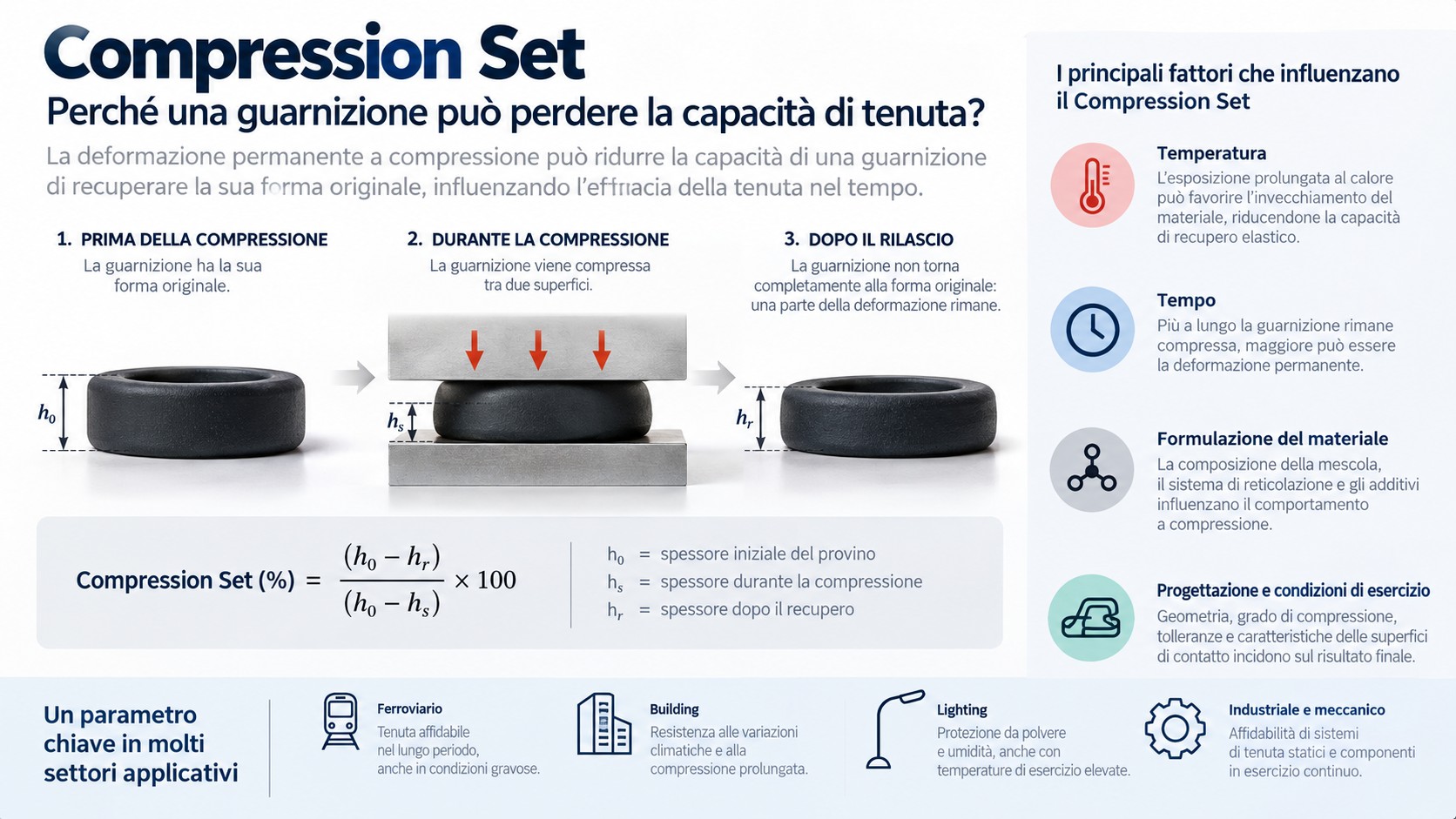
This phenomenon is called compression set, or permanent deformation under compression, and it is one of the parameters to consider when designing rubber and silicone components meant to perform over time. Compression set: how permanent deformation forms and which factors influence it.
What is compression set and why does it matter?
Imagine a gasket installed between two metal surfaces.
During assembly it is compressed and develops a reaction force that helps maintain contact between the surfaces, preventing the passage of liquids, air or dust.
Over time, however, the material can undergo permanent deformation: even when the pressure is removed, the gasket does not fully recover its initial thickness.
Compression set describes precisely this residual deformation.
A low value generally indicates better elastic recovery under the test conditions, while a high value signals greater permanent deformation.
This does not mean that compression set directly measures sealing. A gasket can lose effectiveness for other reasons as well, related to geometry, assembly or conditions of use.
It is, however, an important indicator for assessing how a material may behave during the service life of the component.
Temperature, time and material: what influences compression set?
The behavior of a gasket depends on several factors acting at the same time.
Temperature is one of the most important. Prolonged exposure to heat can accelerate the ageing of the material and change its elastic properties.
Time also plays a decisive role: a gasket that stays compressed for a few hours does not necessarily behave like one subjected to the same pressure for months or years.
Then there is the compound formulation. Two components made from elastomers of the same family can behave differently depending on composition, additives and the manufacturing process.
Finally, design also affects the result: geometry, degree of compression, tolerances and the characteristics of the contact surfaces must be assessed together with the properties of the material.
This is why the choice of a gasket cannot rely solely on hardness or mechanical strength.
How is permanent deformation assessed? The ISO 815-1 and ASTM D395 standards
Compression set is measured through standardized laboratory tests, such as those set out in ISO 815-1 and ASTM D395.
The principle is relatively simple: an elastomer sample is compressed for a defined time, at a given temperature. Once the load is removed, the amount the material manages to recover relative to the initial deformation is measured.
The result is expressed as a percentage.
To interpret it correctly, however, it is not enough to read the figure on the datasheet.
A compression set measured at 70 °C for 22 hours, for example, is not directly comparable with one obtained at 150 °C for 70 hours.
The value is meaningful only when read together with the conditions under which it was measured.
This is particularly important when comparing different materials or evaluating components intended for demanding applications.
Silicone or EPDM: the best material depends on the application
Silicone and EPDM are two families of elastomers widely used to make gaskets and technical components.
Silicone can offer interesting performance in applications characterized by high temperatures, while EPDM is often chosen for its resistance to weathering, water and ozone.
But which of the two has the better compression set?
There is no universal answer.
The behavior depends on the specific compound and on the operating conditions. A formulation optimized for elastic recovery can deliver different results from another belonging to the same family of materials.
For this reason it is important to assess the properties required by the application, rather than simply comparing datasheet values.
Compression set is particularly relevant in applications where gaskets must keep working for extended periods. Just a few examples:
In the railway industry, elastomeric components can be exposed to vibration, temperature variations and continuous operating conditions.
In building, the gaskets used in windows, doors and sealing systems must cope with climate cycles and long periods of compression.
In lighting, the ability to maintain effective contact between surfaces helps protect luminaires from the ingress of dust and moisture.
In all these applications, the behavior of the material over time is as important as its initial characteristics.
Choosing the material starts with understanding the application
Compression set is a good example of how an apparently secondary property can have concrete consequences for the performance of a component.
A gasket can be made from a quality material and perfectly respect the dimensions set by the design. But if its response to operating conditions has not been properly assessed, it may not deliver the expected performance over the long term.
For this reason, when developing technical solutions in elastomer, POSA treats the choice of material, geometry and manufacturing process as parts of a single design path.
The goal is not only to make a component that works at the time of installation, but a solution able to maintain the required performance over time.
Frequently Asked Questions
What does compression set mean?
It is the permanent deformation that remains in an elastomer after it has been subjected to compression for a given period and then released.
Is a low compression set always preferable?
It generally indicates better dimensional recovery under the test conditions, but it must be assessed together with the other properties required by the application.
Which factors most influence compression set?
Temperature, duration of compression, compound formulation and the conditions of use of the component.
Does silicone have a better compression set than EPDM?
Not necessarily. Behavior depends on the formulation of the material and the conditions in which it is used. Comparison requires data obtained under equivalent test conditions.