
Thursday, 18 June 2026
How Is a Custom Solution Created? Long Before the First Component Is Produced
When people talk about rubber or silicone components, they often picture the finished product: a gasket, an extruded profile, a vulcanized frame, or a technical component ready for installation.
In reality, the most important part of the work happens much earlier.
It starts with a phone call, an incomplete drawing, or a problem that nobody has yet managed to solve.
It may be a design engineer looking for a more reliable solution, a purchasing department seeking to replace an obsolete component, or a company developing a new product and realizing that no standard solution available on the market truly meets its requirements.
That is when a custom project begins.
It Doesn’t Start with a Catalog. It Starts with the Application.
One of the most common misconceptions is that customization simply means modifying an existing product.
In reality, the process is usually the exact opposite.
Everything starts with the application itself: the environment in which the component will operate, the stresses it will endure, and the objectives it must achieve.
The question is not: “Which product do we need?”
The question is: “What does it need to do?”
Will it have to withstand high temperatures? Come into contact with aggressive chemicals? Ensure long-term sealing performance? Integrate into a lighting system? Operate in food-grade or pharmaceutical environments?
Every answer changes the project.
Expertise Is Not in the Component. It’s in the Questions.
Those who have been developing technical components for many years know that the most important information is often not included in the drawing.
This is why the initial consultation is so critical.
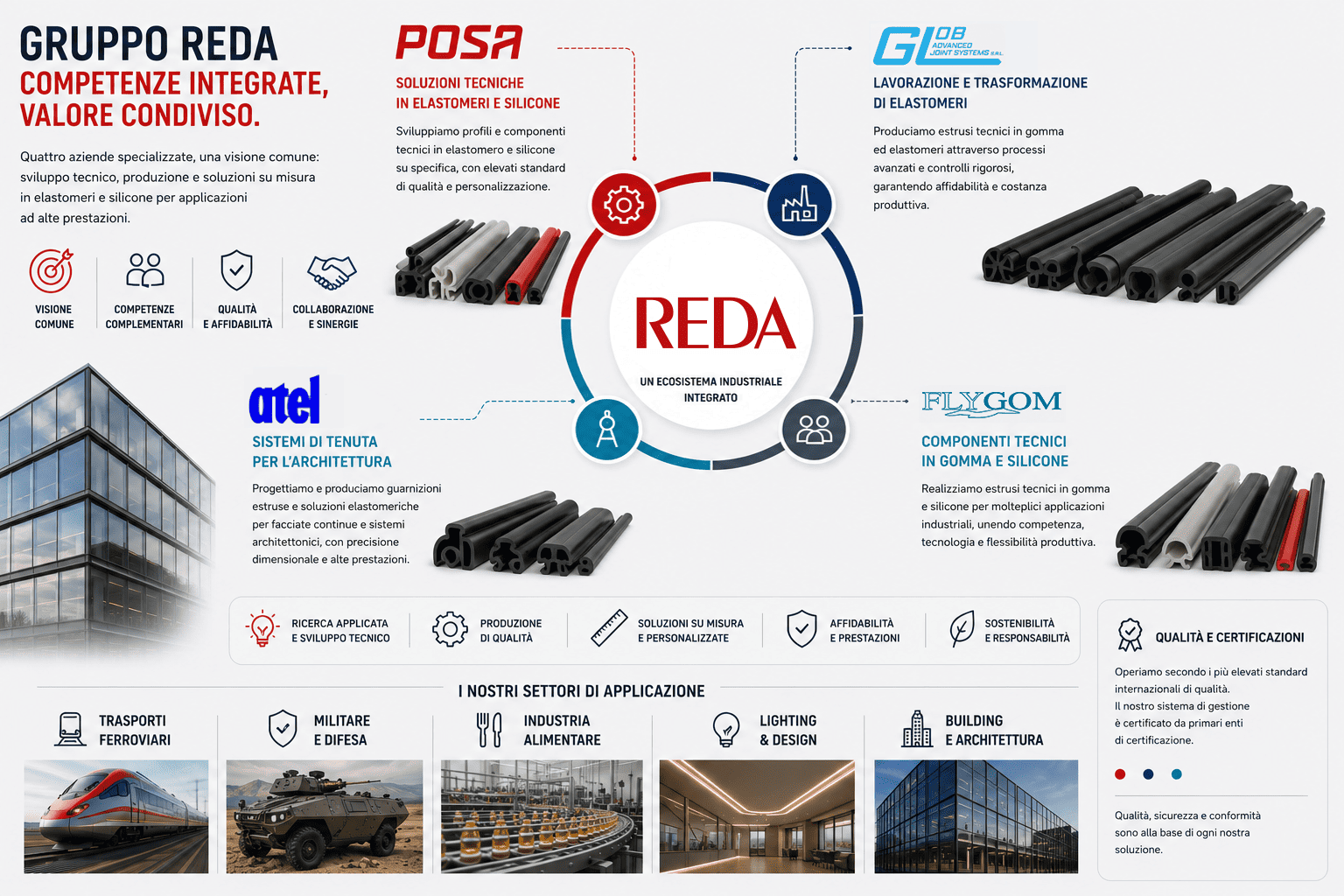
Within the Reda Group companies—POSA, ATEL, Glob, and Flygom—a significant part of the work involves analyzing the application context before production is even discussed.
Sometimes a seemingly minor detail can completely change the material selection or the geometry of the component.
This is where experience and know-how make the difference.
Every Material Tells a Different Story
Silicone, EPDM, NBR, specialty compounds.
Each material comes with unique characteristics.
Some offer exceptional temperature resistance. Others are designed for long-term outdoor durability. Others are specifically engineered for highly aggressive environments or applications requiring particular certifications.
The choice is never based on habit.
It is based on suitability.
The selected material must be the most appropriate one for the specific task.
And very often, the difference between a solution that performs reliably and one that creates problems years later originates in this phase.
From Concept to Prototype
As specifications begin to take shape, the project enters a more tangible stage.
Drawings, simulations, dimensional verifications, and testing.
A prototype is not only intended to confirm that the component is correct.
More importantly, it helps determine whether the project is moving in the right direction.
Because in many cases, the best solution is not the one initially envisioned, but the one that emerges through collaboration between the customer and the technical partner.
The Real Challenge Is Repeatability
Producing a sample component is relatively straightforward.
Producing thousands of meters or thousands of parts while maintaining consistent quality is a completely different challenge.
This is why industrialization, quality control, and manufacturing processes are essential parts of product development.
The challenge is not simply creating the component.
The challenge is ensuring that it continues to perform consistently after thousands of production cycles.
Why Custom Solutions Are Becoming Increasingly Important
Markets are evolving.
Building, lighting, food processing, pharmaceuticals, railway, military, and oil & gas sectors all require increasingly specific performance characteristics that are often incompatible with standardized products.
For this reason, customization is no longer the exception.
It is becoming the rule.
Companies are looking for partners capable of understanding their projects, not simply supplying a component.
A Component Is Only the Visible Part
When a custom solution works well, everything appears simple.
The component is installed, performs its function, and often goes almost unnoticed.
Behind that simplicity, however, lie hours of discussions, material expertise, testing, revisions, and engineering decisions.
It is work that is rarely seen.
Yet that is exactly where real value is created.
Frequently Asked Questions
When is it worth developing a custom solution instead of using a standard component?
A custom solution becomes worthwhile when a standard component cannot fully meet the application’s requirements. These may involve mechanical performance, chemical resistance, operating temperatures, dimensional constraints, or specific regulatory requirements.
What information is needed to start a custom project?
A finalized drawing is not always necessary. In many cases, information about the application, operating environment, and required performance is sufficient. From there, a technical consultation process can begin to define the most suitable solution.
How is the most suitable material selected?
Material selection depends on the component’s operating conditions. Temperature, chemical exposure, durability requirements, flexibility, certifications, and compatibility with the final product are all factors that influence the decision.
Can custom components be developed for industries with specific requirements?
Yes. Custom solutions are used across many industries, including building, lighting, food processing, pharmaceuticals, oil & gas, military, and transportation. Each sector presents unique requirements that demand appropriate materials, geometries, and manufacturing processes.
How important is supplier involvement during the early stages of a project?
Involving a technical partner from the beginning often helps identify improvement opportunities that may not emerge later in the process. Collaboration between engineering, material development, and production helps reduce risks, lead times, and industrialization costs.
What is the difference between customization and co-engineering?
Customization involves adapting a component to a customer’s requirements. Co-engineering goes further: the customer and technical partner work together to develop the solution, sharing expertise, experience, and objectives from the earliest project stages.
What advantages does a tailor-made solution offer?
A custom-developed solution can improve final product performance, increase reliability, simplify assembly, reduce maintenance costs, and provide greater long-term durability.
How long does it take to develop a custom component?
It depends on the complexity of the project. Some solutions can be developed relatively quickly, while more complex applications require additional design, prototyping, testing, and validation activities.
Is it possible to improve an existing component?
Absolutely. Many projects originate from the need to optimize components already in use by improving performance, durability, ease of installation, or compatibility with new applications.
Why are companies increasingly demanding custom solutions today?
Because end products are becoming more specialized. As a result, the need for components specifically engineered to meet precise requirements is growing, replacing reliance on generic market standards.
Share on: